If you are searching for the biggest lakes in the US, the short answer is Lake Superior. With about 31,700 square miles of water area, it is the largest of the Great Lakes and the largest lake associated with the United States by surface area.
There is one important qualification: Lake Superior is shared by the United States and Canada. If you mean the largest lake located entirely within the United States, the answer is Lake Michigan, which covers about 22,300 square miles.
This guide ranks the largest major natural lakes by surface area, explains why different lists sometimes disagree, and separates natural lakes from reservoirs. That distinction matters because “biggest” can mean surface area, volume, depth, or even the portion of a lake inside U.S. borders.
Quick Answer: What Is the Biggest Lake in the US?
Lake Superior is the biggest lake associated with the United States by surface area.
It has a water area of approximately 31,700 square miles, a maximum depth of 1,332 feet, and a volume of about 2,900 cubic miles at low water. It borders Minnesota, Wisconsin, and Michigan in the United States and Ontario in Canada.
If the requirement is that the entire lake must be inside the United States, Lake Michigan is the largest.
Biggest US lakes at a glance
| Rank | Lake | Approx. water area | Key distinction |
| 1 | Lake Superior | 31,700 sq mi | Largest overall |
| 2 | Lake Huron | 23,000 sq mi | Shared with Canada |
| 3 | Lake Michigan | 22,300 sq mi | Largest entirely within the US |
| 4 | Lake Erie | 9,910 sq mi | Shallowest Great Lake |
| 5 | Lake Ontario | 7,340 sq mi | Smallest Great Lake by area |
| 6 | Lake of the Woods | Varies by measurement | Shared by US and Canada |
| 7 | Iliamna Lake | About 1,000+ sq mi | Alaska’s largest lake |
| 8 | Great Salt Lake | Highly variable | Largest saline lake in North America |
| 9 | Lake Okeechobee | About 700+ sq mi | Florida’s largest lake |
| 10 | Lake Pontchartrain | About 600+ sq mi | Large brackish lake |
The five Great Lakes have especially well-established measurements from the U.S. Environmental Protection Agency: Superior 31,700 square miles, Huron 23,000, Michigan 22,300, Erie 9,910, and Ontario 7,340.
The figures for several smaller lakes are less straightforward because lake levels, measurement methods, and definitions vary. For that reason, this article does not pretend that every number is an immutable measurement.
Top 10 Biggest Lakes in the US
The United States is home to thousands of lakes, ranging from small natural lakes to enormous reservoirs created by dams. When ranking the top 10 biggest lakes in the US, Lake Superior clearly stands out as the largest by surface area. Other major lakes include Lake Michigan, Lake Huron, Lake Erie, and several large reservoirs located throughout the western and central United States.
The Great Lakes dominate the upper end of the list because of their enormous size and depth. However, the country also has impressive inland lakes such as Great Salt Lake, Lake of the Woods, and Iliamna Lake. The exact ranking can change depending on whether lakes are measured by surface area, water volume, or whether shared international lakes are included.
For a surface-area comparison, the largest U.S. lakes generally include Lake Superior, Lake Michigan, Lake Huron, Lake Erie, and Lake Ontario, followed by several large natural lakes and reservoirs. This makes the United States one of the most lake-rich countries in the world.
Largest Lakes in the U.S. by Volume
When lakes are ranked by water volume, the results are somewhat different from a surface-area ranking. A lake can cover a huge area but contain less water than a smaller lake if it is relatively shallow. Depth therefore plays an important role when determining the largest lakes by volume.
Lake Superior is the standout example. It is not only the largest of the Great Lakes by surface area but also contains more water than any other lake in the United States. Its tremendous depth and enormous basin allow it to hold a vast quantity of freshwater.
Other Great Lakes, particularly Lake Michigan and Lake Huron, also rank extremely high by volume. Together, the Great Lakes contain a significant share of the world’s surface freshwater. When comparing U.S. lakes by volume, it is therefore important to distinguish between surface area and total water storage.
Biggest Lakes in the US by Area
The biggest lakes in the US by area are led by the Great Lakes. Lake Superior has the largest surface area, followed by Lake Michigan and Lake Huron. Lake Erie and Lake Ontario are also among the largest, although Lake Ontario is considerably smaller in surface area than the other four Great Lakes.
A typical surface-area ranking of major U.S. lakes looks like this:
- Lake Superior
- Lake Michigan
- Lake Huron
- Lake Erie
- Lake Ontario
- Great Salt Lake
- Lake of the Woods
- Iliamna Lake
- Lake Oahe
- Lake Okeechobee
The ranking can vary depending on whether the list includes only lakes entirely within the United States or also includes lakes shared with Canada. Reservoirs are another important consideration because some man-made lakes are larger than many famous natural lakes.
Top 20 Biggest Lakes in the US
The top 20 biggest lakes in the US include a mixture of natural lakes, the Great Lakes, and large reservoirs. If the ranking is based on surface area, the Great Lakes occupy several of the leading positions, while major reservoirs become increasingly prominent further down the list.
Some of the best-known large lakes include Lake Superior, Lake Michigan, Lake Huron, Lake Erie, Lake Ontario, Great Salt Lake, Iliamna Lake, Lake Oahe, Lake Okeechobee, and Lake Sakakawea.
When creating a top-20 list, it is useful to state the measurement being used. Surface area is generally the easiest way to compare lake size, while volume provides a better indication of how much water a lake actually contains. Seasonal changes can also affect the surface area of certain lakes, particularly shallow lakes and reservoirs.
Top 30 Biggest Lakes in the US
Expanding the list to the top 30 biggest lakes in the US reveals how geographically diverse America’s largest lakes are. These lakes can be found from Alaska and the Great Lakes region to Florida, the Great Plains, and the western states.
Large natural lakes such as Lake Superior, Lake Michigan, Lake Huron, Great Salt Lake, Iliamna Lake, and Lake Okeechobee are joined by major reservoirs including Lake Oahe, Lake Sakakawea, Fort Peck Lake, Lake Powell, and Lake Mead.
A top-30 ranking is particularly useful because it provides a broader picture of America’s largest bodies of inland water. However, readers should always check whether a particular ranking includes reservoirs, international lakes, and lakes located partly outside the United States, since those choices can change the order.
Largest Lakes in North America
North America contains some of the world’s most remarkable freshwater lakes, and several of the continent’s largest lakes are located partly or entirely in the United States. The Great Lakes form the most famous group, consisting of Superior, Michigan, Huron, Erie, and Ontario.
Lake Superior is the largest by surface area and is shared by the United States and Canada. Lake Michigan is unique because it is the only Great Lake located entirely within the United States. Lakes Huron, Erie, and Ontario are shared between the two countries.
Beyond the Great Lakes, North America has many other enormous lakes, including Great Bear Lake and Great Slave Lake in Canada and Iliamna Lake in Alaska. This makes North America an important region for freshwater resources and some of the largest lakes on Earth.
Top 20 Largest Man-Made Lakes in the U.S.
The top 20 largest man-made lakes in the U.S. are primarily reservoirs formed by constructing dams across major rivers. These reservoirs were developed for purposes such as hydroelectric power, irrigation, flood control, municipal water supply, recreation, and drought management.
Some of the most significant large reservoirs include Lake Mead, Lake Powell, Lake Oahe, Lake Sakakawea, Fort Peck Lake, and Lake Cumberland. Their size can fluctuate considerably depending on rainfall, river inflow, water demand, and regional drought conditions.
Unlike natural lakes, reservoirs can experience substantial changes in both water level and surface area. For this reason, rankings of the largest man-made lakes should specify whether they are based on maximum surface area, normal pool surface area, storage capacity, or another measurement.
Biggest Lakes in the US Besides the Great Lakes
If you want to discover the biggest lakes in the US besides the Great Lakes, there are plenty of impressive options. The country has enormous natural lakes and reservoirs outside the Great Lakes region.
Some of the most notable examples include Great Salt Lake in Utah, Iliamna Lake in Alaska, Lake Okeechobee in Florida, Lake Oahe in the Dakotas, Lake Sakakawea in North Dakota, and Fort Peck Lake in Montana.
These lakes demonstrate that America’s largest bodies of water are not limited to the Great Lakes. Alaska, in particular, has several exceptionally large natural lakes, while the central and western United States contain some of the country’s biggest man-made reservoirs.
5 Biggest Lakes in the US
For a quick answer, the 5 biggest lakes in the US by surface area are generally represented by the five Great Lakes: Lake Superior, Lake Michigan, Lake Huron, Lake Erie, and Lake Ontario.
However, there is an important distinction when using the phrase “in the US.” Some of these lakes are shared with Canada, so they are not entirely located within U.S. territory. Lake Michigan is the only one of the five that lies completely inside the United States.
If the goal is to identify the five largest lakes entirely within U.S. borders, the list changes significantly. In that case, large lakes such as Iliamna Lake, Great Salt Lake, and Lake Okeechobee become much more important.
List of Biggest Lakes in the US
A list of the biggest lakes in the US can be organized in several ways. The most common method is surface area, but rankings can also be based on volume, maximum depth, or water-storage capacity.
Some of the names that frequently appear near the top of U.S. lake rankings include:
- Lake Superior
- Lake Michigan
- Lake Huron
- Lake Erie
- Lake Ontario
- Great Salt Lake
- Iliamna Lake
- Lake Oahe
- Lake Okeechobee
- Lake Sakakawea
- Fort Peck Lake
- Lake Powell
- Lake Mead
- Lake of the Woods
- Lake Cumberland
Because different sources use different definitions, a reliable lake-size article should explain its ranking criteria. This makes the information easier for readers to understand and prevents confusion between natural lakes and reservoirs.
Top 50 Biggest Lakes in the US
The top 50 biggest lakes in the US provide a much more complete look at the country’s largest inland waters. Such a ranking includes famous Great Lakes as well as natural lakes in Alaska, Florida, Utah, and other states, along with large reservoirs created throughout the country.
A top-50 list can be especially useful for travelers, geography enthusiasts, anglers, boaters, and anyone researching America’s freshwater resources. The farther down the ranking you go, the more important the definition of “lake” becomes because large reservoirs can compete directly with natural lakes.
For the most accurate comparison, each lake should ideally be listed with its surface area, location, type, and whether it crosses an international or state boundary. This provides more useful information than simply giving the names in numerical order.
Top 25 Biggest Lakes in the US
The top 25 biggest lakes in the US represent a combination of massive natural lakes and large reservoirs. The Great Lakes remain dominant at the top when shared lakes are included, while other major lakes become increasingly important farther down the ranking.
Alaska contributes several exceptionally large natural lakes, while states such as Utah, Florida, Montana, North Dakota, South Dakota, and Arizona are known for major lakes and reservoirs.
For an SEO-friendly lake ranking, it is helpful to provide more than just a numbered list. Adding details such as state, surface area, lake type, and interesting facts gives readers a reason to continue exploring the article and makes the ranking more informative.
Biggest Lakes in the US Ranked
The biggest lakes in the US ranked by surface area begin with Lake Superior when the Great Lakes are included. Lake Michigan and Lake Huron follow, while Lake Erie and Lake Ontario also rank among the continent’s largest freshwater bodies.
After the Great Lakes, the ranking becomes more diverse. Large natural lakes in Alaska and Utah and enormous reservoirs throughout the western and central United States enter the picture.
It is important to remember that there is no single ranking that works for every purpose. A ranking by surface area measures the amount of land covered by water, while a ranking by volume measures the total amount of water stored. As a result, the same lake may occupy different positions depending on the measurement.
Biggest Lakes in the US in Order
Putting the biggest lakes in the US in order requires choosing a consistent measurement. Surface area is normally the simplest option because it allows lakes of different types to be compared using the same basic measurement.
At the top of a surface-area ranking are the Great Lakes, followed by other large natural lakes and reservoirs. However, rankings can differ between sources because water levels change, especially in reservoirs and shallow lakes.
For this reason, an authoritative article should mention the measurement and explain whether Canadian-American shared lakes and man-made reservoirs are included. This small clarification makes a lake ranking much more transparent and useful to readers.
How This Ranking Works
Before comparing individual lakes, it helps to define what “biggest” means.
For the main ranking, surface area is the deciding measurement. The focus is on major natural lakes rather than combining natural lakes and reservoirs into one list.
That distinction prevents several common errors.
Surface area
Surface area measures how much water covers the lake’s basin at a particular water level.
Volume
Volume measures how much water the lake actually contains. A lake with a smaller surface area can contain more water than a larger, shallower lake.
Maximum depth
Depth identifies the deepest point. It does not determine the lake’s surface-area ranking.
International borders
Some lakes extend across the United States-Canada border. Their total lake area is different from the area located within the United States.
Changing water levels
Some lakes, particularly Great Salt Lake and reservoirs, can change substantially in area as water levels rise and fall.
Editorial note: Because these measurements are not equally stable for every lake, the Great Lakes use current EPA physical-feature data, while more variable lakes are described with appropriate qualifications rather than a false impression of precision.
1. Lake Superior
Lake Superior is the clear leader when the question is which is the biggest lake in the US by surface area.
Its water area is about 31,700 square miles. It is also the largest Great Lake by volume and the deepest, with a maximum depth of 1,332 feet. EPA lists its volume at approximately 2,900 cubic miles.
Lake Superior touches Minnesota, Wisconsin, and Michigan on the U.S. side and extends into Ontario, Canada.
Why Lake Superior is different
Its enormous size is matched by its depth. The average depth is about 483 feet, meaning that the lake is not simply a huge shallow basin. It holds an extraordinary amount of freshwater.
Its northern location and large volume also contribute to cold-water conditions and a long water-retention time. EPA gives Lake Superior a retention time of about 191 years, meaning the average replacement of its water occurs very slowly compared with the other Great Lakes.
The lake is important for shipping, fishing, tourism, recreation, wildlife, and freshwater resources.
Bottom line: Lake Superior is the answer when someone asks for the biggest lake associated with the United States.
2. Lake Huron
Lake Huron covers approximately 23,000 square miles, making it the second-largest lake associated with the United States.
It borders Michigan and Ontario, Canada.
Lake Huron has a maximum depth of about 750 feet and an average depth of approximately 195 feet. Its shoreline, including islands, extends for about 3,827 miles, according to EPA data.
One of its most distinctive features is its complex geography. Georgian Bay and Saginaw Bay form major parts of the lake system, while numerous islands contribute to its extensive shoreline.
Why its ranking sometimes causes confusion
Lake Huron is slightly larger than Lake Michigan by surface area, but Lake Michigan has a unique geographic distinction: it is entirely within the United States.
So:
- Lake Huron: larger by total surface area
- Lake Michigan: largest Great Lake entirely within the US
That distinction explains why different searches can appear to produce different answers.
3. Lake Michigan
Lake Michigan has a water area of approximately 22,300 square miles, making it the third-largest Great Lake by surface area.
It is the only Great Lake located wholly within the United States. Its shoreline reaches Illinois, Indiana, Michigan, and Wisconsin.
That makes it the answer to one of the most common related questions:
What is the largest lake entirely within the United States?
Lake Michigan.
Lake Michigan’s importance
Lake Michigan is unusual among the largest U.S. lakes because of the population centers surrounding it. The southern basin includes major metropolitan areas such as Chicago and Milwaukee, while the northern portions are less densely developed. EPA describes the southern basin as the most urbanized part of the Great Lakes system.
The lake supports transportation, recreation, fishing, tourism, wildlife, and communities throughout its watershed.
Its maximum depth is approximately 925 feet, and its average depth is about 279 feet.
4. Lake Erie
Lake Erie has a water area of approximately 9,910 square miles, placing it fourth among the Great Lakes.
It borders Michigan, New York, Ohio, Pennsylvania, and Ontario.
Lake Erie is much shallower than the other Great Lakes. Its average depth is about 62 feet, while its maximum depth is approximately 210 feet.
Why Lake Erie is important
Its shallow water warms relatively quickly, and its physical characteristics make it biologically different from the deeper Great Lakes.
EPA describes Lake Erie as the shallowest, warmest, and most biologically productive of the Great Lakes. It also has a heavily developed watershed with major cities and extensive agricultural land.
The lake supports fishing, recreation, shipping, tourism, and communities throughout the surrounding region.
5. Lake Ontario
Lake Ontario is the smallest of the five Great Lakes by surface area, covering approximately 7,340 square miles.
It borders New York and Ontario, Canada.
Despite having the smallest surface area among the Great Lakes, it is considerably deeper than Lake Erie. EPA lists its maximum depth at approximately 802 feet and its average depth at about 283 feet.
This is a useful example of why surface area and volume should not be treated as the same thing.
Lake Ontario is also the final Great Lake in the chain before water continues through the St. Lawrence River toward the Atlantic Ocean.
The Five Great Lakes Compared
The Great Lakes dominate the U.S. lake rankings because their size is extraordinary compared with most other natural lakes in the country.
| Great Lake | Water area | Maximum depth | Volume |
| Superior | 31,700 sq mi | 1,332 ft | 2,900 cu mi |
| Huron | 23,000 sq mi | 750 ft | 850 cu mi |
| Michigan | 22,300 sq mi | 925 ft | 1,180 cu mi |
| Erie | 9,910 sq mi | 210 ft | 116 cu mi |
| Ontario | 7,340 sq mi | 802 ft | 393 cu mi |
EPA’s current physical-features table gives these measurements at low-water conditions.
The table reveals an important point: Lake Huron has a larger surface area than Lake Michigan, but Lake Michigan contains more water by volume.
That is exactly why “largest” needs a definition.
What Are the Five Great Lakes?
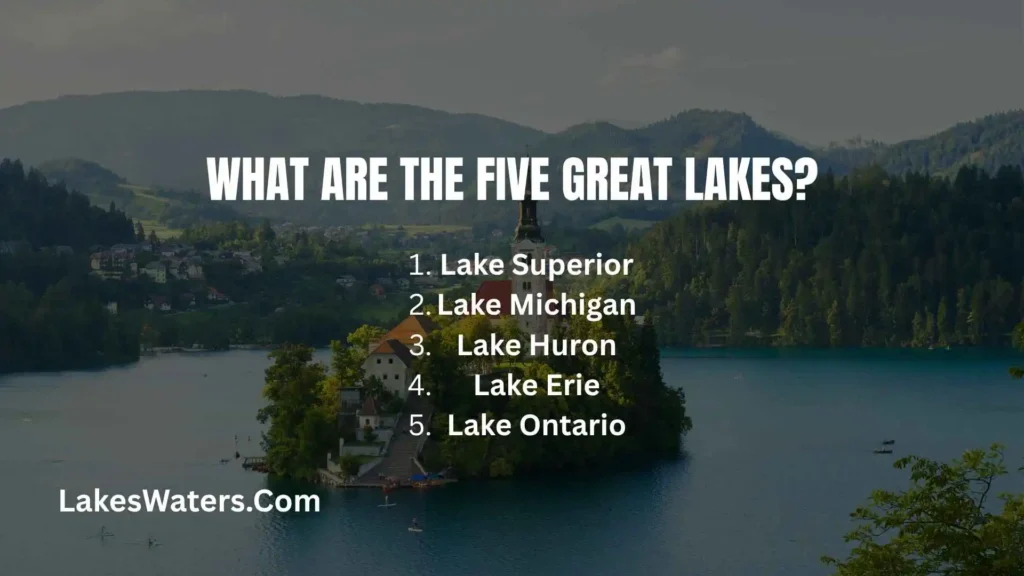
The five Great Lakes are:
- Lake Superior
- Lake Michigan
- Lake Huron
- Lake Erie
- Lake Ontario
Together, they cover about 94,250 square miles of water.
They are shared by the United States and Canada and form one of the world’s largest surface freshwater ecosystems. EPA says the Great Lakes contain about 21% of the world’s surface freshwater supply and about 84% of North America’s surface freshwater.
Their importance extends far beyond their size. The lakes support drinking-water supplies, transportation, power production, recreation, fisheries, tourism, and wildlife.
6. Lake of the Woods
Lake of the Woods is one of the largest natural lakes outside the Great Lakes system.
It lies across Minnesota, Manitoba, and Ontario, making it another example of why the definition of “U.S. lake” matters.
The lake’s total area is often reported differently depending on the source and measurement method. Historical USGS data list the lake at about 1,485 square miles, while other commonly cited figures use different boundaries or measurements. USGS also distinguishes between the total lake and the portion within the United States.
Why Lake of the Woods is worth including
Its complicated international geography makes it a useful example of the difference between:
- total lake area;
- U.S. lake area; and
- U.S. watershed area.
It is known for islands, fishing, boating, forests, wetlands, and outdoor recreation.
Rather than giving it an artificially exact rank, it is more accurate to describe it as one of the largest natural lakes outside the Great Lakes.
7. Iliamna Lake
Iliamna Lake is Alaska’s largest lake and one of the country’s largest natural freshwater lakes.
It lies in southwestern Alaska in a remote landscape of mountains, rivers, forests, and wildlife habitat.
Its exact ranking can vary between datasets because lake measurements and definitions differ, but its importance is not in doubt: it is a major freshwater system and one of the largest lakes in the United States outside the Great Lakes.
Why Iliamna Lake stands out
Iliamna is especially important for fisheries and wildlife. The surrounding Bristol Bay region is globally significant for salmon, and Iliamna’s connected waters support major fish populations.
The lake also has an unusual ecological feature: Alaska officials have documented harbor seals living in freshwater in the Iliamna Lake system.
For travelers and geography enthusiasts, its remote Alaskan setting also makes it very different from large lakes surrounded by major cities.
8. Great Salt Lake
Great Salt Lake in Utah needs special treatment because it is not a freshwater lake and does not have a fixed surface area.
USGS describes it as the largest saline lake in North America. It occupies a closed basin, meaning there is no natural river outlet carrying water toward the ocean. Water leaves the system primarily through evaporation.
Why its size changes
The lake’s surface area rises and falls with changes in water level.
That means a statement such as “Great Salt Lake covers exactly X square miles” can be misleading unless the elevation and date are also provided.
Its unusual chemistry and changing water level make it one of the most distinctive large lakes in the United States.
It is also an important habitat for birds and other wildlife and is closely tied to the environmental conditions of northern Utah.
Key point: Great Salt Lake belongs in discussions of America’s largest lakes, but its ranking should always be presented with a water-level qualification.
9. Lake Okeechobee
Lake Okeechobee is Florida’s largest lake and one of the most important water bodies in South Florida.
Its commonly cited surface area is roughly 700-plus square miles, although exact figures vary depending on the measurement method and water level.
Unlike Lake Superior, Lake Okeechobee is remarkably shallow relative to its surface area. That difference makes it a good real-world example of why a lake’s area alone does not tell you how much water it contains.
Why Lake Okeechobee matters
The lake is a central component of South Florida’s water-management system.
It is connected to:
- Water supply
- Flood management
- Agriculture
- Wildlife habitat
- Fishing
- Recreation
- Regional water flows
Its shallow basin and surrounding water-management infrastructure make it fundamentally different from the Great Lakes.
10. Lake Pontchartrain
Lake Pontchartrain in Louisiana is another large and unusual water body.
It covers roughly 600-plus square miles and is generally described as a brackish estuarine lake, meaning its water has a mixture of freshwater and saltwater characteristics.
Its location near New Orleans gives it major importance for wetlands, wildlife, fisheries, transportation, recreation, and storm-related environmental management.
Lake Pontchartrain is also a reminder that a list of the “biggest lakes” does not necessarily consist entirely of deep freshwater lakes.
Largest Lake Entirely Within the United States

The answer is Lake Michigan.
Its approximately 22,300-square-mile water area is entirely within the United States.
This distinction is important because Lake Superior is larger but crosses the U.S.-Canada border.
The easiest way to remember the difference is:
Largest overall: Lake Superior
Largest entirely in the US: Lake Michigan
There is no contradiction between these answers. They use different geographic criteria.
Largest Lake in a Single US State
If the requirement is that the entire lake must lie within one U.S. state, Alaska becomes especially important.
Iliamna Lake is Alaska’s largest lake and is one of the largest major natural lakes located entirely within a single state.
Alaska’s enormous size and glacial landscape account for its unusually large number of lakes.
This category should not be confused with “largest lake entirely in the United States,” because a lake can cross state boundaries while remaining completely inside the country.
Natural Lakes vs. Reservoirs
A major problem with online lake rankings is that some lists combine natural lakes and reservoirs without clearly labeling them.
That can make an apparently simple “top 10” list misleading.
A natural lake is a naturally formed inland body of standing water.
A reservoir is an artificial or substantially managed water body, often created by damming a river.
For a geographic ranking of America’s natural lakes, it is better to keep reservoirs separate.
What about Lake Oahe?
Lake Oahe is a major example.
The U.S. Army Corps of Engineers identifies Lake Oahe as a reservoir created by the Oahe Dam on the Missouri River. At a specified elevation of 1,607.5 feet, USACE lists approximately 310,000 surface acres, or about 484 square miles.
Its surface area changes with reservoir elevation, which is another reason reservoir rankings need their own methodology.
Lake Oahe is important for flood-risk management, water storage, hydropower, recreation, and wildlife.
So while it is absolutely appropriate to discuss Lake Oahe when comparing large U.S. reservoirs, it should not be silently inserted into a ranking of natural lakes.
Surface Area vs. Volume: Which Lake Is Actually “Bigger”?
This is one of the most useful distinctions when comparing large lakes.
The surface area measures the lake’s footprint.
Volume measures the amount of water.
Depth measures how deep the water gets.
Those measurements can produce different winners.
For example, Lake Huron has a slightly larger surface area than Lake Michigan:
- Huron: 23,000 sq mi
- Michigan: 22,300 sq mi
But Lake Michigan has a greater volume:
- Michigan: 1,180 cubic miles
- Huron: 850 cubic miles
Lake Superior leads both categories among the Great Lakes.
This is why a high-quality lake ranking should always state which measurement is being used.
Why Different Websites Give Different Lake Rankings
If you compare several lists of the biggest U.S. lakes, you may notice that the order or numbers are not always identical.
That does not automatically mean one source is wrong.
Water level
The lake area changes as water rises or falls.
This is particularly important for Great Salt Lake and reservoirs.
International boundaries
A source may report the total area of a cross-border lake or only the portion inside the United States.
Measurement date
Different datasets may have been collected decades apart.
Lake definition
Some sources may include connected bays or use different geographic boundaries.
Natural lakes vs. reservoirs
A natural-lake ranking will look different from a ranking that includes synthetic, reservoirs.
Best practice: When comparing lake sizes, always check the source, measurement date, definition, and whether the figure represents total or U.S.-only area.
Common Misconceptions About America’s Biggest Lakes
Is Lake Michigan the biggest lake in the US?
Not by total surface area. Lake Superior is larger.
Lake Michigan is the largest Great Lake located entirely within U.S. borders.
Is Lake Huron bigger than Lake Michigan?
Yes, by surface area. Huron covers about 23,000 square miles compared with Michigan’s 22,300.
Is Lake Superior the deepest lake in America?
No.
Lake Superior is the deepest of the Great Lakes, but Crater Lake in Oregon is deeper than Lake Superior.
Are all five Great Lakes in the United States?
All five are connected to the United States, but only Lake Michigan lies entirely within the country. The other four are shared with Canada.
Is Great Salt Lake freshwater?
No. It is a saline lake in a closed basin.
Is Lake Oahe a natural lake?
No. It is a reservoir created by the Oahe Dam project on the Missouri River.
Why America’s Largest Lakes Matter
The largest lakes in the United States are important for reasons far beyond geography.
Freshwater
The Great Lakes are one of the world’s largest surface freshwater ecosystems. EPA estimates that they contain about 21% of the world’s surface freshwater supply.
Transportation
The Great Lakes form a major inland transportation network, connecting ports and industrial regions in the United States and Canada.
Recreation and tourism
Large lakes support boating, fishing, swimming, hiking, camping, sailing, wildlife watching, and beach recreation.
Wildlife
Large lakes and their surrounding wetlands provide habitat for fish, birds, mammals, amphibians, and other species.
EPA currently estimates approximately 532,938 acres of Great Lakes coastal wetlands, demonstrating that the ecological footprint of the lakes extends far beyond their open-water surface.
Water management
Large reservoirs have additional functions. Lake Oahe, for example, is part of a managed Missouri River system and supports multiple water-management and recreational purposes.
Which Big US Lake Is Right for Your Interest?

If you’re comparing these lakes for a specific reason, the answer depends on your goal.
For the largest surface area:
Choose Lake Superior.
For the largest lake entirely within the US:
Choose Lake Michigan.
For a remote Alaskan freshwater experience:
Look at Iliamna Lake.
For a unique saline ecosystem:
Look at Great Salt Lake.
For Florida’s largest lake:
Look at Lake Okeechobee.
For a major human-made reservoir:
Compare Lake Oahe with other large reservoirs using reservoir-specific measurements.
This is more useful than simply asking which lake is “best,” because each lake has different geography, water characteristics, and uses.
Frequently Asked Questions
What is the biggest lake in the US by surface area?
Lake Superior is the largest lake associated with the United States by surface area, covering approximately 31,700 square miles. It is shared by the United States and Canada.
What is the largest lake entirely in the US?
Lake Michigan is the largest Great Lake located entirely within the United States, with a water area of about 22,300 square miles.
What are the five biggest Great Lakes?
In order by surface area, they are:
- Lake Superior
- Lake Huron
- Lake Michigan
- Lake Erie
- Lake Ontario
EPA’s current water-area figures are 31,700, 23,000, 22,300, 9,910, and 7,340 square miles, respectively.
Which is bigger, Lake Superior or Lake Michigan?
Lake Superior is larger. Its water area is about 31,700 square miles, compared with 22,300 square miles for Lake Michigan.
Which is bigger, Lake Huron or Lake Michigan?
Lake Huron is larger by surface area: approximately 23,000 square miles compared with 22,300 square miles for Lake Michigan.
What is the largest lake in Alaska?
Iliamna Lake is Alaska’s largest lake and one of the largest natural lakes in the United States outside the Great Lakes.
What is the largest lake in Florida?
Lake Okeechobee is Florida’s largest lake. Its surface area is commonly reported at roughly 700-plus square miles, with the exact figure depending on the measurement and water level used.
Is Great Salt Lake one of the biggest lakes in America?
Yes. It is one of America’s largest saline lakes, but its exact ranking changes because its surface area varies substantially with water level. USGS identifies it as the largest saline lake in North America.
Why isn’t Lake Oahe included with the natural lakes?
Because Lake Oahe is a reservoir, not a natural lake. USACE created it through the Oahe Dam project on the Missouri River.
What is the deepest Great Lake?
Lake Superior, with a maximum depth of approximately 1,332 feet.
Does the largest lake also contain the most water?
Not always. Surface area and volume are different measurements. Among the Great Lakes, however, Lake Superior leads in both surface area and volume.
Final Takeaway
The answer to “What is the biggest lake in the US?” is Lake Superior when the ranking is based on total surface area.
But the more precise answer depends on what you are measuring:
- Largest overall: Lake Superior
- Largest entirely within the United States: Lake Michigan
- Largest Great Lake by volume: Lake Superior
- Largest lake in Alaska: Iliamna Lake
- Largest lake in Florida: Lake Okeechobee
- Largest saline lake in North America: Great Salt Lake
- Major large reservoir: Lake Oahe, which should be ranked separately from natural lakes
The key is to define “largest” before comparing lakes. Surface area, volume, depth, international boundaries, water levels, and whether a body of water is natural or synthetic can all change the result.
For reliable research, federal sources such as the U.S. Environmental Protection Agency, U.S. Geological Survey, and U.S. Army Corps of Engineers are preferable to relying on unsourced listicles or copying rankings from other websites.

I am Sophia Bennett, an environmental storyteller who explores the fascinating world of lakes, freshwater habitats, and natural ecosystems.
I write to educate and inspire people about water conservation, biodiversity, and the importance of maintaining clean water resources.
I believe that understanding nature is the first step toward protecting it.
Books by Sophia Bennett:
- Whispers of the Freshwater World
- The Journey of Water: From Source to Sustainability